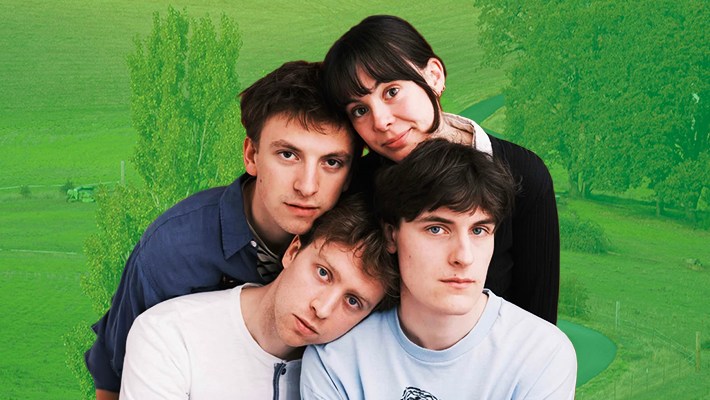
It Goes On, the scrappily invigorating full-length debut by the U.K. band Westside Cowboy, opens with one of the year’s most exciting rock songs. A rousing mess of relentlessly chugging guitars and shout-along vocals, “Kick Stones (The Boys)” captures the spirited energy of a pub band that imagines it’s playing Wembley Stadium. As the track builds from jittery, tense strums to a crescendo of noise, the prospect of this band commanding a stadium stage feels, quite shockingly, plausible.
According to singer/guitarist Jimmy Bradbury and drummer Paddy Murphy, the core of the Manchester quartet’s artistic mission was to embrace a sound that is refreshingly straightforward. In an era where modern English indie has been dominated by the proggier, more theatrical sensibilities of bands like Black Midi and Black Country, New Road, Westside Cowboy is intentionally pivoting toward something more primal. They describe their aesthetic as a blend of American and British roots, a tongue-in-cheek genre tag they call “Britainicana.”
Returning to the Roots of Rock
For Bradbury and Murphy, the goal was never to replicate the polished stadium rock of the early 2000s. Instead, they looked to the raw, unvarnished energy of the Velvet Underground. “It’s about having these raggedy things pushed as far as they can go,” Murphy explains. “We just wanted to go in that direction. I’m not saying that we really got there, but it became a new place to shoot for.”
This desire for simplicity is a direct reaction to the complex, art-music trends that have defined the British scene for the past several years. “How can we have fun in a band in as concise a way as possible?” Bradbury asks. “Instead of having six people on stage, let’s try and just do it with the most stock rock thing we could do — two guitars, bass, and drums, and write a song with three chords.”
The DIY Ethos of Britainicana
The band’s fascination with history extends to the mid-1950s skiffle movement, which Bradbury identifies as one of the first true DIY youth music scenes in England. Inspired by figures like Lonnie Donegan, the band briefly experimented with the genre, finding beauty in the idea of kids making instruments out of tea chests and broom handles just to participate in the music they loved. While Westside Cowboy is far from a traditional skiffle act, that spirit of accessibility remains a cornerstone of their identity.
Ultimately, the band isn't trying to start a revolution or rewrite the history of rock music. They are simply looking to reclaim the joy and freedom of the genre. As Murphy notes, “We saw a real joy and freedom in trying to dumb everything back down again. We just wanted to have fun with our fans.” In doing so, they have managed to carve out a space that feels both nostalgic and entirely new, proving that sometimes the most radical thing a band can do is keep it simple.