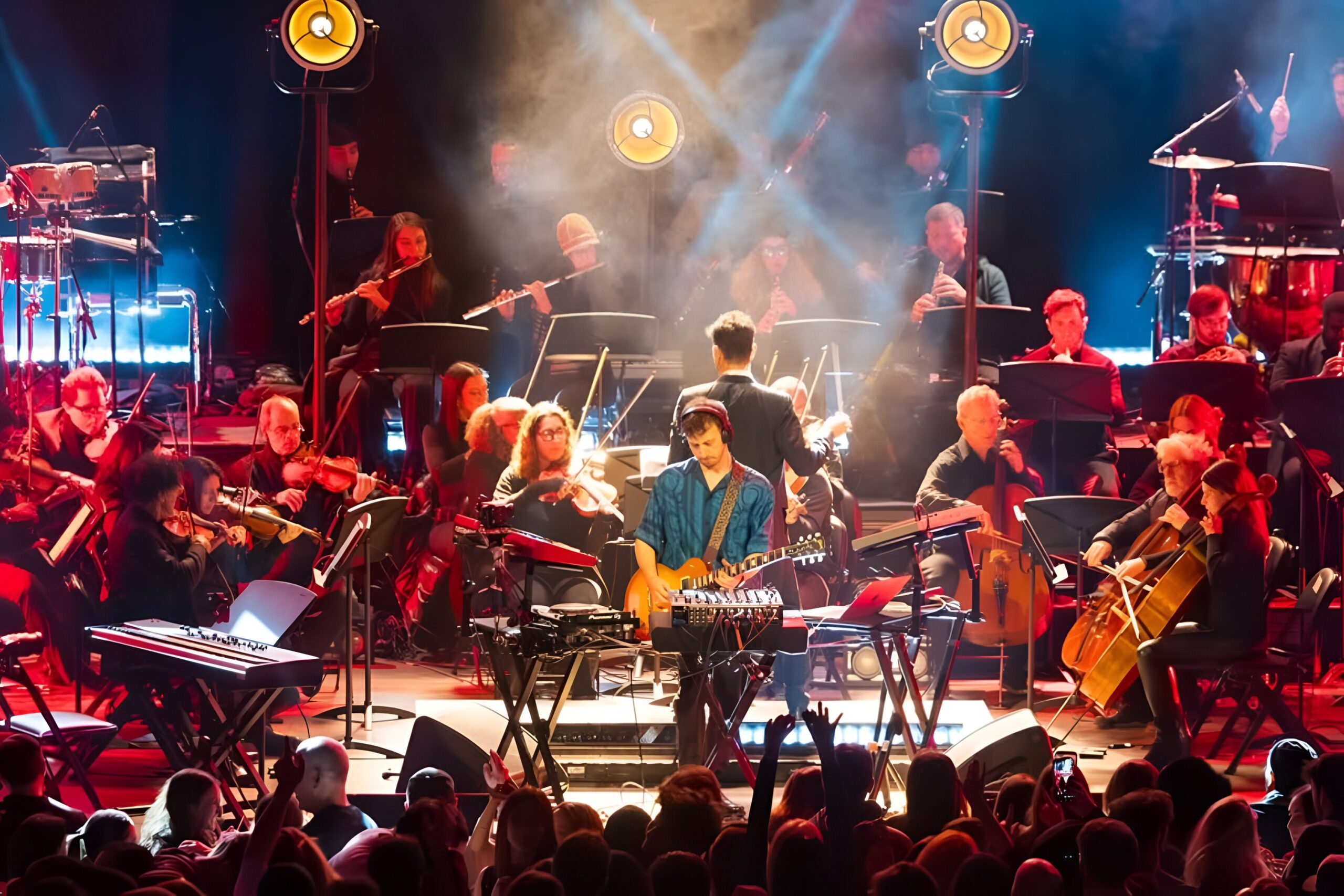
Sometimes I feel reassured about the direction of my musical listening when I witness one of the producers I admire most expand his artistic horizons beyond DJing, synthesizing sounds, and sculpting atmospheres on the dancefloors. There’s something compelling about seeing an artist fuse the skills they dominate with traditions that historically belong elsewhere.
Photo Credit: Stranger Than – Official
Such is the case with Mita Gami, who in recent years has pushed his work beyond the club by developing an orchestral project that merges electronic music with symphonic composition. To bring this vision to life, he’s partnered with composer and conductor Meir Briskman, whose background in orchestral writing helped translate Mita’s identity into a format capable of existing both inside and outside the rave environment.
Although the project first debuted in 2022, one of its most visible moments occurred at the Mayan Warrior during Burning Man 2024, where an assembled 37-piece orchestra performed alongside Mita’s music. That presentation placed the hybrid concept firmly in the public conversation and suggested that this wasn’t a one-time experiment, but the beginning of a broader artistic direction. The DJ and producer, along with the conductor, had already presented the project in several cities, yet it was after the footage from Burning Man circulated online that I began to suspect a New York debut was around the corner. The announcement arrived in December of 2025. On Saturday, February 7th,2026, the orchestral project finally reached the Brooklyn Paramount, hosted by Stranger Than.
The show was masterful. A breath of fresh air, and a powerful reminder that there are still artists out there striving to innovate. It deepened the regard in which I already held him, reinforcing my view of Mita Gami as one of the most compelling DJs and producers working today, and a personal favorite. The choice of Brooklyn Paramount could not have been more fitting: an immaculate theater whose grandeur matched the scale the performance demanded, performed alongside a 45-piece orchestra.
I was struck by the immense size of the audience in the room. Since 2024, awareness surrounding both Mita Gami and his projects, particularly Maccabi House, the platform he leads alongside Adam Ten, has grown noticeably and is beginning to reach a broader public. At least when it comes to the music these two are creating, influencing, and championing, it’s clear that their listeners are embracing a level of production that can genuinely enrich one’s musical life.
Their sound feels exceptional, stimulant, and textured with psychedelic detail.; distinct from much of today’s house landscape. It’s the kind of music that lifts the spirit, activates the body entirely, and makes it nearly impossible to resist the urge to physically embody every beat.
It was that same music, the productions released by Mita Gami, that he merged with the orchestra. From what I can recall, the set opened with ‘Come Say Love,’ one of the earliest releases on Maccabi House, subtly introducing the dialogue between classical instrumentation and electronic structure. Shortly afterward came what I consider his most iconic production to date, ‘All By Myself,’ which has also become central to the orchestral project. Hearing it performed live was beyond description.
Reimagined versions of ‘Allenby’ and ‘Hello’ followed, their violin lines and expanded percussion revealing emotional dimensions that felt newly magnified in this format. Two deliberate silences were used to build tension ahead of Beethoven’s Fifth Symphony, while the transition into ‘California Dreamin’ restored momentum with striking fluidity. Spending that night there felt deeply fulfilling.
I consider Mita Gami among the producers currently shaping some of the most forward-thinking currents in house music. Around him, there’s a growing generation crafting sounds that are immersive, psychedelic, “all over the place” but groove-driven, and emotionally charged without surrendering rhythmic impact. What fascinates me most is their ability to make me appreciate sonic territories that lie outside my usual listening habits.
Great artists expand the perimeter of our taste. They pull us out of aesthetic comfort and redirect our curiosity toward the unfamiliar. That’s precisely what this orchestral project achieves. There is something profoundly rewarding about developing an interest in places one might never have expected, such as finding myself captivated by a classical project despite my longstanding inclination toward synthetic textures.
If this performance is any indication, the orchestral project is not a detour but a widening of scope. And despite having originated several years ago, it now feels as though it is only beginning.