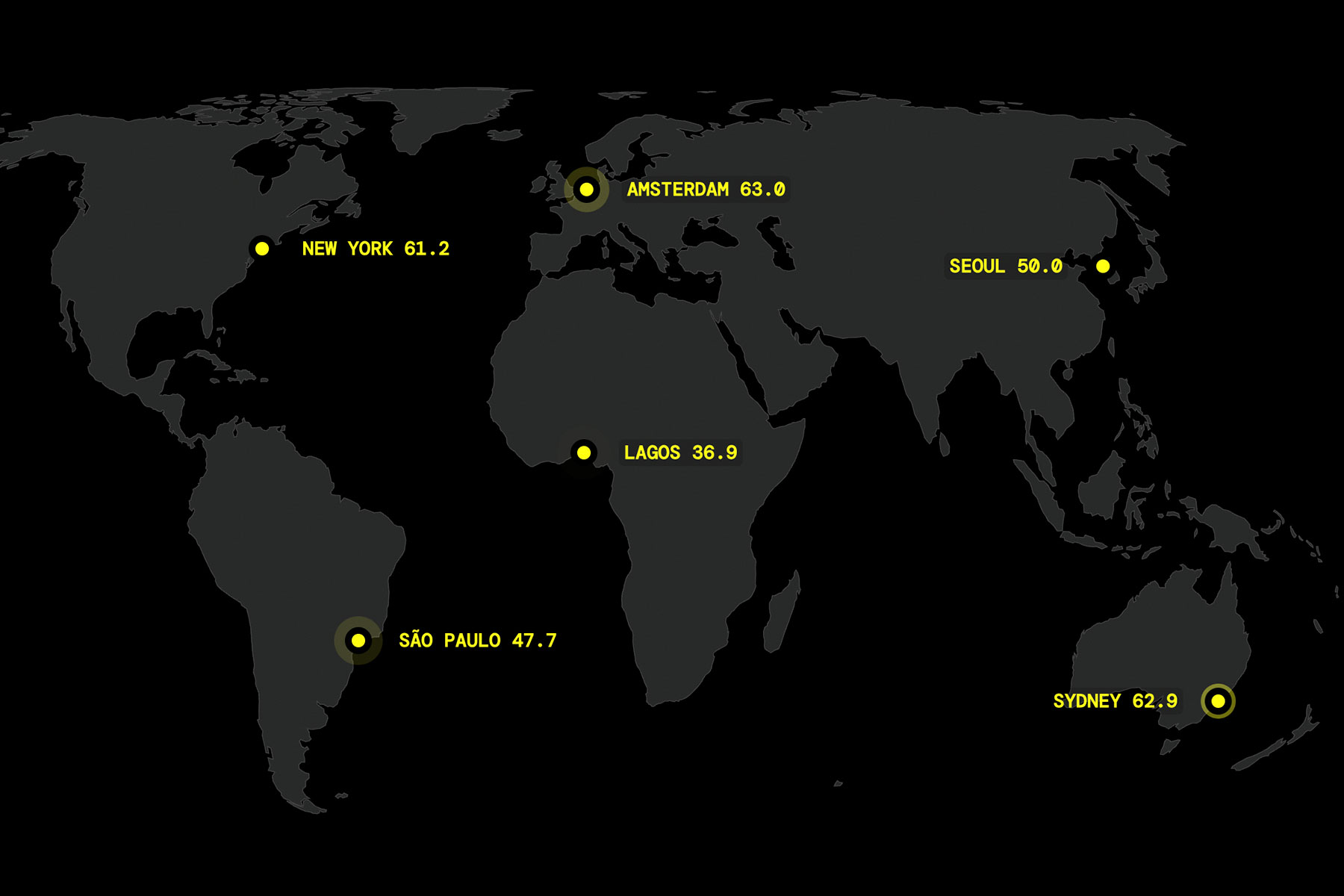
Amsterdam Dance Event (ADE) and VibeLab have officially launched the Nighttime Culture Index, a groundbreaking research initiative designed to measure the vitality and accessibility of nightlife across six major global cities: Amsterdam, Lagos, New York, São Paulo, Seoul, and Sydney. Introduced during the 30th anniversary of ADE, this project provides a comparative dashboard and a detailed summary report that examines the critical conditions supporting or restricting nighttime culture.
The study, led by VibeLab in collaboration with local research coordinators, evaluates six core dimensions: Creative Ecology, Space & Infrastructure, Diversity & Representation, Community & Belonging, Policy & Civic Health, and Sustainability & Environment. To ensure a comprehensive analysis, researchers processed data from over 12,000 event lineups, assessed more than 3,000 venues, and reviewed nearly 30,000 non-musical cultural events. The findings were further enriched by a public survey involving over 700 participants, alongside insights from 67 focus group members and 14 industry experts.
Economic Barriers and Representation
One of the most significant findings of the index concerns the affordability of nightlife. When measured against local minimum wages, the cost of entry to a typical club night varies drastically. In Sydney, entry costs approximately one hour of work, while in Amsterdam, it requires 1.3 hours. The burden increases in Seoul (1.7 hours) and New York (1.8 hours), rising sharply to nine hours in São Paulo and approximately 25 hours in Lagos, excluding additional costs like transportation and drinks.
The research also highlights persistent inequalities regarding representation. Across the six cities, women and gender-diverse artists represent only 27% to 32% of event lineups. Furthermore, experts in five of the six cities characterized the diversity of venue leadership and ownership as poor, signaling a need for systemic change.
Safety and Policy Implications
Safety remains a critical challenge for the nighttime economy. In São Paulo, 73% of respondents reported feeling safe inside venues, yet that number plummeted to 11% for the surrounding streets. Similarly, in Lagos, 74% felt safe inside, compared to only 20% outside. These figures underscore the disconnect between the internal environment of cultural spaces and the public infrastructure surrounding them.
“You can’t have a nighttime industry without a nighttime culture, and that culture depends on people being able to take part. When a club night costs a day’s wages or more in some cities, that is a question for all of us, including the industry.” — Jan-Willem van de Ven, Managing Director of Amsterdam Dance Event.
The report also notes that while local governments are increasingly recognizing the economic value of nightlife through dedicated offices, there is a continued tendency to prioritize economic output over the cultural and social roles these spaces play. The Nighttime Culture Index serves as a vital baseline, offering stakeholders—including policymakers, artists, and venue operators—the tools to evaluate current conditions and track progress toward a more inclusive and sustainable future for global nightlife.