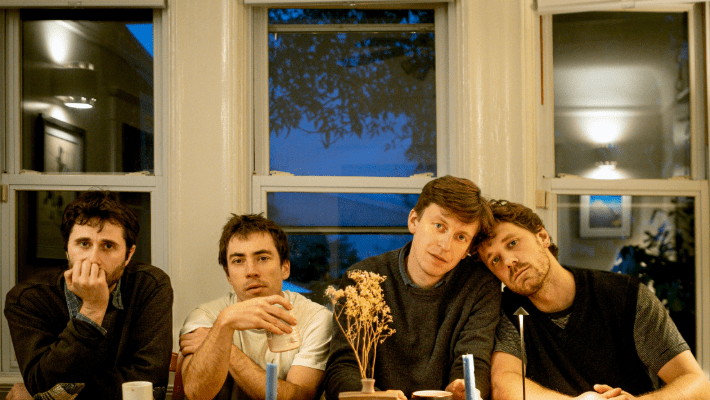
To hear the members of Mildred tell it, their band didn’t form so much as fall into place. Around 2022, three of the four members—singer-guitarist Henry Easton Koehler, Jack Schrott, and singer-bassist Matt Palmquist—were living together in a Berkeley house, bonding over beers and the music of Silver Jews. They were in their early 30s, balancing day jobs and academic pursuits, all while navigating the quiet isolation of the pandemic era.
During those months, drummer Will Fortna would drop by while visiting from out of town, and their casual hangouts inevitably turned into jam sessions. Over time, those impromptu moments evolved into fully realized songs. The result is Fenceline, the band’s full-length debut and arguably one of the most endearing indie sleepers of 2026.
A Sound Built on Organic Chemistry
Fenceline feels like a record born from a specific time and place. It carries the spirit of David Berman’s work, filtered through a Northern California lens that nods to the classic folk-rock sensibilities of The Band and Crosby, Stills, Nash & Young. The album is defined by its low-key, observational character studies and a live-in-the-room production quality that highlights the band's natural, embroidery-like instrumental interplay.
“It all happened very organically,” says Fortna, reflecting on the band’s formation. “We didn’t have any real designs to start making a ‘band’ band or playing shows. We just started playing music in the house they were living in, before dinner and after dinner in the living room.”
The band’s collaborative process is notably ego-less. Koehler notes that the songwriting is porous, with each member contributing ideas, lyrics, and arrangements. “The process really revolved around us playing together every week,” Koehler explains. “Band members would bring pretty raw, unfinished snippets of songs and we would just flesh them out together.”
Defining the Mildred Sound
When asked about the band’s name, the members admit it was chosen for its unpretentious, grounded quality. “I like that it’s not cool or edgy or flashy because I feel like we’re none of those things,” Fortna says. That lack of artifice is exactly what makes Fenceline resonate. It is a record of simple, unassuming pleasures—from the sudden cut-off of a guitar solo on “Fish Sticks” to the campfire-echoing harmonies of “Charlie.”
As the band looks toward their next batch of songs, they remain committed to their democratic, leaderless structure. While they acknowledge that most bands rely on a “chain of command,” Mildred finds that their shared self-awareness and humor keep the project moving forward. For now, they are content to let the music grow as naturally as it started, proving that sometimes the best bands are just a group of friends who happen to be excellent at listening to one another.